Visuals
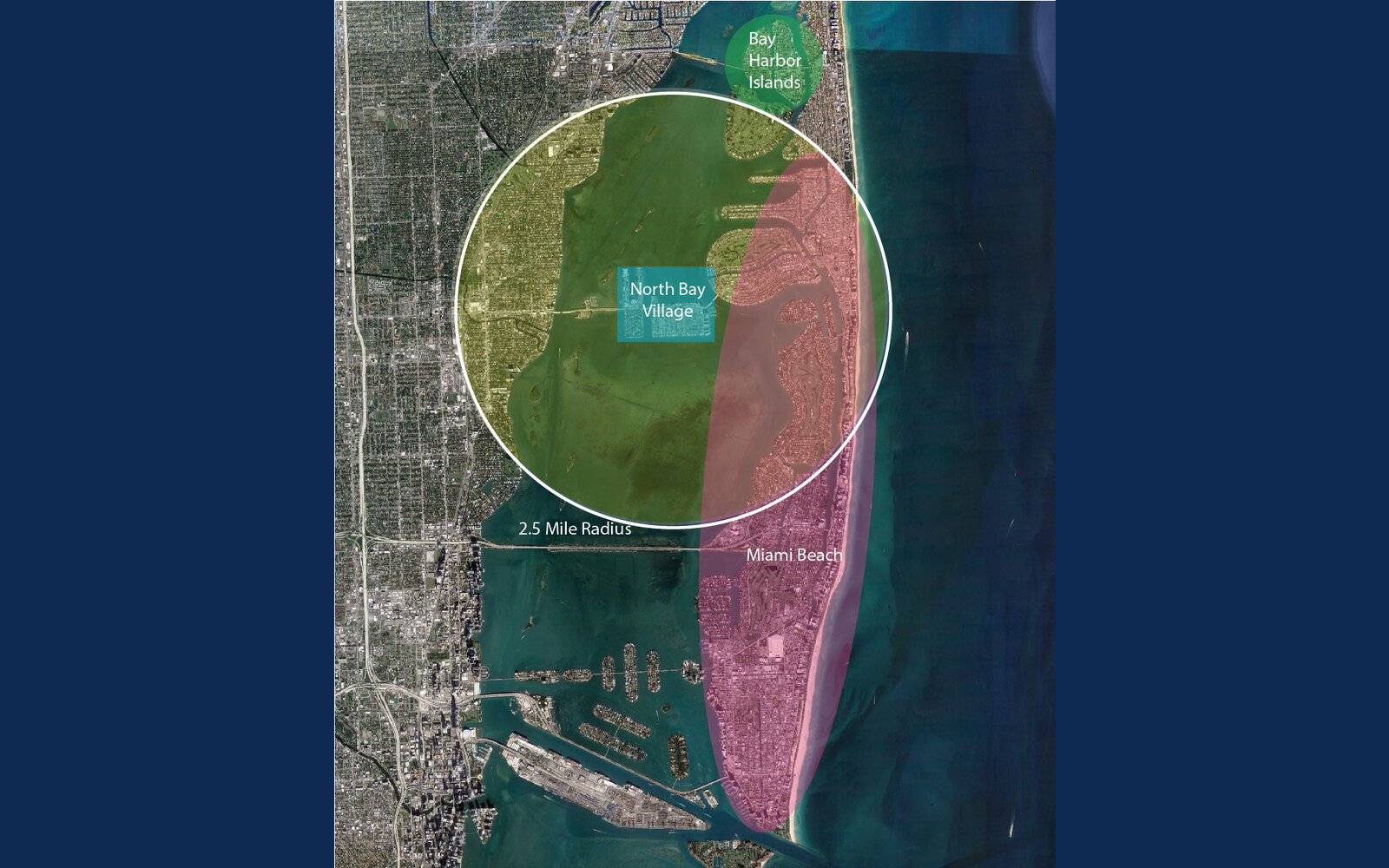
The market study areas
An economic and fiscal impact analysis making the case for a 7.3-million-square-foot, mixed-use waterfront destination on the JFK Causeway — and quantifying what it returns to North Bay Village.
Sunbeam envisioned a new landmark destination for North Bay Village — a mixed-use project of 1,936 luxury apartments, a 300-room upscale hotel, Class A office, and restaurants, entertainment, and retail across three sites on both sides of the John F. Kennedy Causeway, wrapped around a marina, a production studio, civic open space, and a public island walk.
BusinessFlare® was engaged through the Euclid Group to prepare an independent Economic & Fiscal Impact Report supporting the project's Special Area Plan. We assessed the Village's real estate, labor, capital, and consumer markets, then quantified the one-time and recurring benefits and the property-tax revenue the development would return to the Village and other taxing authorities.
The up-to-$1.7 billion project is projected to generate $2.9 billion in one-time economic impact and support 17,384 jobs during construction, then deliver $332 million in recurring annual economic output and 4,190 permanent jobs. At a stabilized taxable value approaching $1 billion, it would add an estimated $5.7 million to the Village's General Fund — roughly a 48% increase — plus about $12 million in one-time permits and fees.
From the development program and market fundamentals to the jobs, output, and tax revenue the project returns to North Bay Village.
The Special Area Plan program totals roughly 7.3 million gross square feet on a 562,454-SF assemblage, blending residential, hospitality, office, retail, and civic uses with about 5,000 structured parking spaces.
Benchmarked against Miami Beach, Bay Harbor Islands, a 2.5-mile radius, and Miami-Dade, North Bay Village showed tight vacancy, market-leading rents, and sub-5% cap rates signaling strong investor confidence — but almost no room to grow.
Placer.ai foot-traffic and consumer-spending data confirmed that the Village's residential purchasing power is leaking out for lack of local shops and restaurants — demand the project is designed to recapture.
Using the Emsi input-output model, BusinessFlare® quantified employment, earnings, and total output for both the construction phase and stabilized operations, tracing direct spending through indirect and induced ripple effects.
We modeled ad valorem taxes using both a construction-cost and an income approach to valuation, projecting revenue to the Village, School Board, County, and other authorities over a ten-year horizon.
The assessment ties the project's scale directly to the Village's constraints: strong economic fundamentals held back by limited real estate. The added density and height are what allow the project to recapture leaking spending, house workers locally, and materially expand the tax base.